


Planning for high school biology felt really intimidating. I decided to wait until my three oldest children could all take it together. This way I could limit my torture.

Imagine my happiness when I learned that our co-op was planning to do labs together during the same year that I was planning to do biology with my trio! This is the second time that our co-op has done a biology labs class, so I knew that this would also mean that we would be sharing microscopes. I knew that we could not afford to purchase a microscope, so this would be such a blessing for our family.
To my surprise, none of this year's biology studies has worked out as I had imagined.
It has not been torture. In fact, we have had quite a bit of fun examining God's creation together!
As for the microscope, it turns out that our co-op had so many students register for the class that we wouldn't have had enough microscopes. We would have been forced to have four students per microscope, or something really difficult. In reality, Apologia Science and Nature's Workshop each generously provided a microscope and supplies for my family and our co-op. Such a blessing! And one I would have missed out on.

You see, these microscopes have enabled my teens and the teens at co-op to experience the fascination of science and the thrill of God's creation in a way they would not have been able to without a microscope.
If you are considering doing biology at home without a microscope, I would encourage you to find a way to borrow or buy one. It will add so much to your learning experience!
Just look at the smiles in this video as these two students learn to use the microscope by examining their cheek cells. (This was an experiment from Module 1.)
By the end of the first class time with the microscope, students were finding other items to examine with the microscopes. One set of lab partners looked at some of their hair. Another pair- boys, of course- were a little too clumsy as they were cleaning up. The cover slips that some of the students have break pretty easily. While cleaning, one of these boys broke a cover slip and it cut his finger. Seizing the opportunity, they grabbed a slide and fresh cover slip and examined a drop of blood under the microscope. I was fortunate enough to catch their reactions on video.
[No, this was not approved by any adult. I discovered what was happening just as the slide was going on the microscope. The excited voices gave them away. How can you stop real learning was it’s happening and teenagers are learning to love science? So I documented it, and then we threw the slide away.]
Last week at co-op, we did experiments 4.1 and 4.2– yeast and fungi.
The yeast experiment was a little difficult to do as a group. Everyone was at a different point with the mushroom experiment when the yeast was ready, which means that most people did not really examine the yeast at 5 minutes and at 30 minutes. Some of our results were probably a little skewed, but we did the best we could. You can only make teenagers move so fast. {grin}

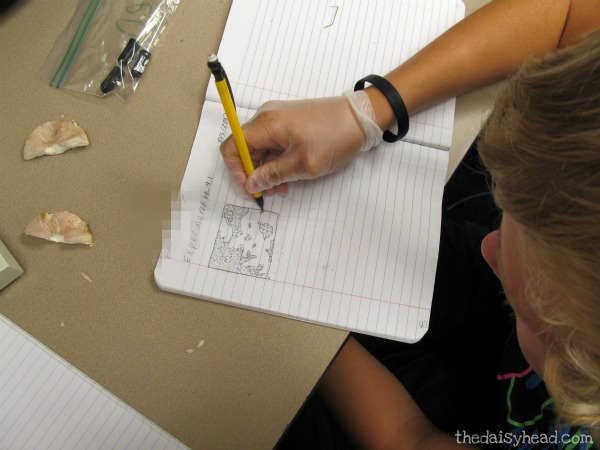
We also examined mushrooms and fungi. This may have been our most challenging lab so far. Several families brought in some samples, so we had several different types. This meant that everyone did not have the same kind of mushroom or fungus, which made it challenging to help students decide if they had spores on their slides or not. Each set of lab partners had to really examine their mushroom and decide how to cut it, etc. because we couldn't give exact directions for every single mushroom. It was a wonderful learning experience for everyone!

I am so glad we are getting the full benefit of our labs because of having our microscopes. And it's such a blessing to be able to share that benefit with the other students in our class!

HomeSchool High is sponsored by Apologia.
I hope you'll tell them a big "thank you"!
~~~~~~~~~~~~~~~~~~~~~~~~~~~~~~~~~~~~~~~~~~~~~
Now it's your turn. What have you been doing this week with your high school teens?
Check out the Link-Up Guidelines, grab a button or banner for your post, and link up your post– old or new.
Be sure to visit some of the other ladies who have linked up! Leave them an encouraging word. Let's link arms, ladies! Spur one another on to the finish!

You are right – it did seem overwhelming to do labs and more at home. But it is FUN. Just as you said, the deeper discovery of God’s creation. Love this post!
This is great, Connie. We’re not at the high school level, yet, but I agree that labs add so much to the kids’ appreciation of science. Thank you for sharing.
My oldest is doing Biology with Prentice Hall this year…I’m kinda wondering if I should’ve stuck with Apologia and gotten everything from them. Your labs look much more interesting!
So, it is more about discovery and wonder than just facts. Always something new and fresh in the universe!
Having taught Apologia Science in a group setting over the past few years, I can say having a microscope is essential to a good study. We even used a microscope on labs that didn’t call for one! Learning experiences just happen – like the blood from the cut! That is a great lab in itself! Apologia biology is so much fun… and isn’t Nature’s Workshop wonderful?!?! Love them. Lots of great science resources!
It is very important to purchase educational microscopes with separate fine focus and coarse adjustments. As much as your budget will allow, avoid the microscopes with either a coarse focus adjustment or an intermediate focus.
Most microscopes that have a built-in light source use either a tungsten, fluorescent or halogen bulb. Fluorescent bulb systems are more expensive than tungsten systems, but the quality of light is brighter and they produce much less heat than either tungsten or halogen systems.
A professional microscope is a tool to aid the pursuit of knowledge and an absolute necessity in many medical, scientific, agricultural and industrial careers. Children are encouraged to investigate and may turn to science careers. Others increase their understanding of the “worlds within worlds”. Through the microscope, ordinary becomes extraordinary!
All good quality educational microscopes have metal parts and absolutely no plastic parts. Look for metal parts especially in the frame, screw fasteners and focusing system. Otherwise, you are stuck with a toy microscope that you could have saved the trouble buying with your money.
I can’t even think about studying biology without microscopes. There are s many benefits of it like :-
They can be used for longer stretches of time as they do not demand the viewer to constantly look through a small lens.
The images can be projected on to a large screen and many people have access to the images at the same time.
These cameras come equipped with zoom lenses that help the viewer control the size and focus of the image.
Since these cameras are much bigger than the conventional microscopes, they can be fixed on to a table or a desk with a curved metal arm. This feature makes them user friendly.