


How do I afford afford a bazillion books?
How do you do it, exactly? Do the children sit at desks?
How do you get them to be still and quiet while you read?

Today we are going to talk about the nitty gritty details of literature-based learning… the practical side of how one actually homeschools with real books.
Truthfully, there is no one right way to homeschool with literature. Every family will work it a little differently. And each family will have seasons of how it works for them. However, I want to share some details of how it has worked in our family in order to give you a very real picture of how literature-based learning could work in your family.
{Note: This post contains affiliate links. Clicking through them does not change your price at all. It just lets the company know that I sent you and I earn a very small percentage of your purchase price. Every little bit adds up to help my family. Thank you!}
How do you pick good books?
It's natural to want to use good literature to teach your children, yet it's impossible to pre-read every book in order to make sure that it is suitable for children's little hearts and minds. For me, if I have not read the book before, I like to know that it's recommended by a source that I trust. Often that means that it's used by Sonlight Curriculum or some other Christian curriculum with similar values to mine, or it's a children's book award winner (like Newberry). Other times the books we choose are favorites from my or Hubby's childhoods. {We'll talk more about resources on Friday.}
Do you have to buy a bazillion books in order to use literature-based learning?
This is a tricky question. No, you do not have to buy lots of books to use literature-based learning as your primary method of homeschooling. However… very soon you will fiind yourself wanting to buy more and more books… and more bookshelves. {grin}
The library has been my best friend for years. It's one of the best sources for good literature, even in the technology age.
How do you do it, exactly? Do the children sit at desks?
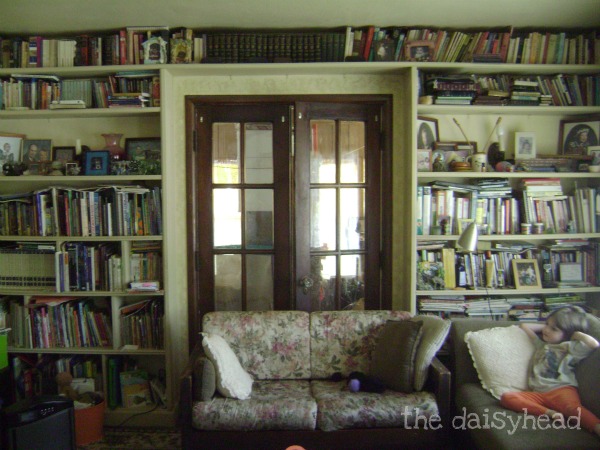
You could have the children sit at school desks if you wanted to, but it's much more fun to read where all of you will be the most comfortable. And learning happens better when they are not preoccupied with the hard chair. We like to pile up on couches to read together!
With my preschool and elementary-aged children, we have sort of a routine that we follow. {This routine is also why my oldest never thought we were doing schoolwork and would tell strangers that we homeschool but never do school work. It was just fun to him. Of course, we then had a little talk about what school work really entailed.} It all starts with breakfast. As they are finishing up with eating, I read the Bible. We read about a chapter each morning and go through a book at a time. Then we work on our memory verse together. Easy and a great start to the day!
A little while later in the day, we sit down on the couch together. Normally I have a child (or two) on either side of me so they can see the pictures. {Instant snuggles.} During this time, we read a history book and then a science book. Of course, we stop several times so I can answer a question or ask them a question or examine the pictures more closely.
At lunchtime, we do some more reading. I am always done eating before the children, so this is a perfect time for our read aloud. Sometimes the read aloud is a biography or historical fiction that coordinates with our history reading {Sonlight is set up this way from Core D on up through the high school cores. And I love it!}, sometimes it's a really good novel or a missionary story. When the children are finished eating, we move to the comfy couch to finish our reading… including the pleas for "One more chapter! Pleeeasssse?!"
At suppertime, the conversation normally starts with, "Tell Daddy what you learned about today." This begins the great narration (telling back what they heard/ comprehension test) that they don't even know they are doing. At this age, I have no reason to test or quiz anyone. I know whether they have learned and understood the information. {Yay for no grading!}

When the children reach middle school, I do not read aloud to them very often. In fact, it's usually just if they want to join the younger ones and listen to one of their favorite books again. Because it's better when Momma reads it with voices. {Yes, they have actually told me this!}
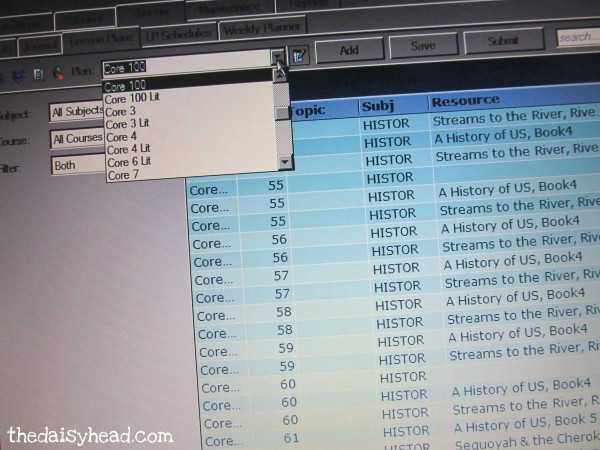
During the middle and high school years, I enter all of the plans from our Sonlight Cores into Homeschool Tracker. This gives them the assignments, and they manage the reading. Sometimes a book is too good to put down, and they read ahead. Then they just manage and juggle the other assignments so that they don't get too far behind in other subjects. Eventually they get through all of the reading.
At some point during the week, they will write a summary of what they have learned, take a quiz or test, and/ or we will have a discussion about their reading.
I also love to schedule movies for the family to watch that go along with what we are learning. Some years this has happened more than others, but we love it when we can manage to coordinate it. Some of these movies are for the whole family– even if it's not the exact subject that everyone has learned about, we still learn something. The historical movies or other movies that are not appropriate for the littler ones happen after they go to bed. At these times we have snacks and a late night movie for school. {How fun does that sound? Late night school that's fun!}
How do you get them to be still and quiet while you read?
I don't.
This one takes some trial and error for each child. Some children need to be still in order to really pay attention, some need to move in order to learn. In order to figure out who is who in your house, you need only ask questions about what you've just read.
My boys really looked like they had no idea what I was reading at all, but when you asked a question or asked them to repeat what you just said, they could tell you everything that you read– almost word for word. My girls really need to be more still to hear what I was reading, but didn't want to sit that still for so long.
We have done several things to make this easier and more enjoyable for everyone. They have played with legos or blocks while I read to them. They have colored. Their favorite is when I find and print coloring pages that coordnate with what we are reading– like cowboys when reading about Western Expansion. They have doodled. My girls like to crochet, plastic canvas, or knit while I read. Sometimes a boy would like to just jump in place or pace around the room while listening. It all works, and as long as I don't stress about it, we all enjoy it.
It's hard to not get caught up in the mindset that a child would need to sit still in order to listen, but we really just need to remember the goal.
We are helping them to learn. If learning needs movement, that's okay.
Tomorrow we'll be discussing more nitty-gritty details… "Will literature-based homeschooling work for my family?"
It's going to be good. Don't miss it!
Find more about this series and links to all the posts here.
This series is a part of iHomeschool Network's Summer Hopscotch 2013. Thirty bloggers have joined together to bring you 5 days of posts on topics that are near and dear to our hearts. {Not all of them are related to homeschooling.} I'd love it if you'd visit some of the other bloggers! You just might find a new passion.
Are the quizzes and tests part of Sonlight? Sorry, not familiar with their system.